Sigh.
Predictably, former prime minister Mikhail Kasyanov has been disqualified from running for president by Russia's Central Elections Commission. The move clears the way for a nice smooth run for Vladimir Putin's chosen successor, Dmitriy Medvedev. He will now run virtually unopposed in the Russian Federation's fifth presidential elections since the fall of the Soviet Union.
Yes, there will be opposition, but only of the token sort. Medvedev's remaining "opponents" are a pair of multi-time losers in Communist leader Gennady Zyuganov and ultranationalist Vladimir Zhirinovsky, as well as a virtual unknown, Andrey Bogdanov. Kasyanov was the only figure Russia's fractured liberal opposition could potentially have rallied around.
Opinion polls showed him trailing badly with less than 2 per cent support (compared to somewhere between 60 and 82 per cent for Medvedev, if the numbers are to be believed), but Kasyanov and his supporters never expected to win power through the Kremlin-controlled ballot boxes.
Though the odds were long, their aim was always to replicate Ukraine's Orange Revolution, with masses crowding Red Square on election day to peacefully protest a vote that everyone knows in advance will be deeply flawed. For that to have any chance of working, they needed a Viktor Yushchenko, a popular candidate to rally around.
One by one the other potential Yushchenkos dropped out or were forced out of the race by the Kremlin: Garry Kasparov, Vladimir Bukovsky, Boris Nemtsov. Now Kasyanov's gone too. So, by and large, is any lingering hope of peaceful democratic change in Russia in the near future.
(It's worth noting here that even Belarus's tyrannical Alexander Lukashenko at least allows an opposition candidate or two to run for president every five years... as did Putin in 2004 when he was confident of his personal popularity. It appears that despite the opinion polls, the Kremlin is less sure than it's letting on about Medvedev's real popular appeal.)
The Kremlin understood the stakes, which is why it pulled out one of the most farcical excuses in their playbook: the falsified signatures charge.
Anyone who doubts this is a canard only has to look back at how it's been used in Russia and across the former Soviet Union over the last 17 years. Either there's a very organized ring of international signature forgers at work (usually in league with those opposed to oppressive regimes) or the autocrats are scared to put their so-called popular support to a real test.
Here's an incomplete list of the invalid signatures phenomenon in post-Soviet elections:
November 1993: The Russian All-People's Union, which included elements of the old Communist Party, is barred from running in the first post-Soviet Duma elections due because of 20,000 falsified signatures.
July 1995: Eight parties barred from Armenia's first post-Soviet parliamentary vote because of falsified signatures.
March 2000: Konstantin Titov, Yevgeny Savostyanov, Ismail Tagi-Zade, and Umar Dzhabrailov are all barred from running for president over allegations of, well, falsified signatures. The elections, you may have heard, were eventually won by a Vladimir Putin.
October 2000: Citing falsified signatures, Azerbaijan's Central Election Committee bans the National Democratic Party from taking part in parliamentary elections .
September 2003: Malik Saidullayev disqualified from Chechnya's presidential elections over falsified signatures. Eventually all serious candidates are forced out of the race, clearing the way for the pro-Kremlin Akhmat Kadyrov (the deceased father of Ramzan) to run almost unopposed.
July 2004: Belarussian human rights group Viasna-96 (or Spring-96) loses its legal standing over charges that it falsified signatures on its registration papers.
December 2004: All opposition parties (all the real ones, anyway) in Uzbekistan are barred from parliamentary elections over signature issues.
November 2006: Opposition candidate Andrei Safonov is barred from running for the post of "president" in Moldova's pro-Russian breakaway province of Transdniestria. Wanna guess the reason?
March 2007: The liberal Yabloko party is barred from running in St. Petersburg municipal elections over falsified signatures.
October 2007: Russia's Green Party, along with the People’s Union and the Party for Peace and Unity, is barred from running in Duma elections over illegal John Hancocks.
January 2008: Kasyanov disqualified.
The list speaks for itself. Managed democracy, indeed.
Ah hell, why not take credit on this rare instance that it's due? As the Why Democracy? website notes in its weekly news roundup, "Canadian journalist Mark MacKinnon predicted Putin's falsified signatures approach a week ago." (See last post.)
I wish it hadn't been so easy. Like I said at the start - sigh.
Showing posts with label chechnya. Show all posts
Showing posts with label chechnya. Show all posts
Sunday, January 27, 2008


Thursday, January 17, 2008
S Novom Godom!

Я желаю Вам хорошее здоровье, удачу и успех в новый год!
Now back to business. I went silent for a little while. Very, very silent. Largely because my day job has been all-consuming of late, what with President Bush's tire-spinning visit to my current home, the Middle East.
That said, I'm off to Baku tomorrow for a weekend of pure relaxation by the Caspian Sea. The thought of returning to even the edge of the old USSR has me thinking:
Candidate Kasyanov - He's got the two million signatures. Does the Kremlin have the courage - and the barest commitment to democracy - to let him run against their man, Dmitriy Medvedev? Or are we going to see another "falsified signatures" charge in the coming days that will again prove that Russia is not inching towards democracy, but sliding back towards authoritarianism.
While we're at it, will Yavlinsky, Nemtsov and co. have the good sense to put their egos aside and back the only man with a hope of giving the Kremlin machine a run for its oil money?
Oleg Kozlovsky - His story is a warning, not only about fading freedom of speech in Russia, but about the biggest peril that many talented young Russians face - the draft. Many of my Russian friends spent most of their 20s doing anything - anything - to avoid being sucked into the dark and dangerous pit that is the Russian army. I've seen kids press-ganged off the streets of St. Petersburg while out walking with friends, and met soldiers in Chechnya whose parents didn't even know they were in the army, let alone stationed in Grozny. I'll wholeheartedly sign on to the Free Kozlovksy campaign, but add a note that there are thousands more like him, leading lower-profile lives, who also deserve our concern.
Much More Misha - Four more years of Saakashvili starts off with his government laying charges against tycoon Badri Patarkatsishvili. Patarkatsishvili's no saint, but neither are Vladimir Gusinsky, Boris Berezovsky and Mikhail Khodorkovsky. If this was Putin laying charges against another oligarch, wouldn't we all be asking questions about whether the President isn't really just trying to quash all political opposition?
British Council tomfoolery - If the Russian government thinks the British Council is a den of spies, it should produce the evidence and expel those it no longer wants in the country. Otherwise, it should sending spooks to follow Council staff around St. Petersburg. It's an embarrassing saga, and not for the British.
Kosovo: I've asked the question before: why is the West so insistent that Serbia is divisible, but not Kosovo? (And not Georgia or Moldova?)
Azerbaijan 2016 - C'mon, really? This what President Ilham Aliev wants to spend all the oil money on? An expensive, sure-to-fail Olympics bid? What about the hundreds of thousands of Azeris who live in poverty, just outside the Baku bubble?
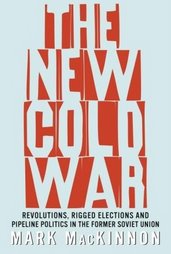
February 5: If it was the $26.95 that was keeping you from buying The New Cold War, never fear. The paperback edition hits bookshelves Feb. 5.
Monday, December 3, 2007
Russia chooses authoritarianism

It was, as Vladimir Putin has proclaimed the morning after, a "doubtless success." According to official results, his United Russia party won upwards of 64 per cent of the vote in yesterday's Duma elections. According to Vladimir Vladimirovich himself, that translates into 315 of the 450 seats in parliament.
That two-thirds majority in the Duma allows Putin and his acolytes to alter the constitution. They can abolish term limits so that Putin can run again in the presidential vote this spring. They can rename the country Putinistan.
There's no question now that Vladimir Putin will continue to dominate the Russian political scene after his term ends next year. If he doesn't find a way to retain the presidency (and I remain convinced that he will), he'll be the most powerful prime minister Russians have had since the post was created. If he's neither president nor PM, he'll be the man who yanks the strings on both.
It all seems so anti-democratic. And yet, yesterday's election results - and the passivity with which Russians went to the ballot boxes to lend their endorsement to what's going on - reminds us again that Putin has done all this with the consent of the vast majority of Russia's 142 million citizens.
Never mind the weak protests from the OSCE and American-backed NGOs like Golos. The West can kick and scream all it wants (with justification) about media manipulation and suppression of dissent under Putin. But take a drive 100 kilometres outside of Moscow - or better yet, fly to any city east of the Ural Mountains - and you'll see that the liberal elite whose rights we're so concerned with don't represent more than a tiny minority of Russians.
The masses voted for Putin yesterday - and will again if he finds a way to run for president - because their lives are far better now than they were under the Western-sponsored "freedom" and "democracy" of the Boris Yeltsin years. They, like the country, are back on their feet again economically after the economic chaos of the 1990s, and they give Putin nearly all the credit for the turnaround.
(A recent Kommersant examination of the Putin era found that "the country’s history has hardly seen another period when the prosperity of the population improved at such a fast rate." The newspaper reported that Russians' real incomes had grown from 6,087 rubles a year in 2000, the year he took office, to 11,425 in 2006.)
That Putin could preside over eight years that included the Kursk submarine disaster, the Nord-Ost theatre siege debacle and the Beslan school massacre and still be seen as a "stability" president speaks to how disastrous the Yeltsin years - and Western policy towards Russia immediately after the end of the Cold War - really were.
Much has been made of the Kremlin's near-complete control over the airwaves, and rightly so. The fact that most of the country gets little news beyond what they see on state-controlled television has definitely warped the Russian political map in Putin's favour. But whenever I travelled in Siberia and suggested as much to the reputedly brainwashed people who lived in the Russian heartland, they'd scoff indignantly. They're not stupid, was the reply. After decades of living in the Soviet Union, they know when they're being told the truth and when they're not. Better than any Westerner, they can spot propaganda when they see it.
My argument here is not that the elections were "free and fair." I've written just last week about what a fraudulent process this election is. No one can or should believe that 99 per cent of Chechens voted for United Russia, as Ramzan Kadyrov and his thugocrats are claiming.
What I'm saying is that Russians aren't fooled as easily as many seem to think. Rather than rising up and demanding better, they went to the polls yesterday and cast their ballots. By doing so, whether they voted for United Russia or not, they tacitly backed what Putin's been doing, and whatever he'll do next.
Yes, there were instances of intimidation, but so far such reports are few and far between. With far more thought and experience than most outsiders give them credit for, the majority of Russians have chosen resoundingly chosen to back Putin's vision for their country's course.
They've chosen security and oil-fuelled economic growth over freedom and democracy. Likewise, they've backed an independent, often anti-Western course on the international scene rather than bowing to Washington's leadership.
A day after Putin's "doubtless success," it's time the West accepted that, together with all its many implications.
(For more on this theme, Mikhail Gorbachev, in a fascinating interview with the Wall Street Journal, said he supports Putin and the "transitional democracy" he believes Putin is creating. Gorbachev also claims Dick Cheney once admitted to him that the West wanted to keep Russia on his knees. For those without a WSJ account, lawyer-blogger Robert Amsterdam has posted a full transcript here.)
Friday, July 20, 2007
War without end

I keep hearing that the war in Chechnya is now over, and reading nice features in places like the New York Times and Newsweek about how pleasant it is to visit Grozny these days. Then you scan the news wires and get a very different image.
With a nod to La Russophobe, here's a look back at the week that was in "peaceful" Chechnya and the neighbouring republics of Dagestan and Ingushetia.
Interfax: Two policemen killed in attack in Chechnya - July 19 2007
AP: Drunken Russian soldier in Chechnya kills 1 officer and wounds 3 - July 19, 2007
Interfax: Seven wounded in blast at cemetery in Ingushetia (AP later puts number of injured at 10) - July 18 2007
Interfax: Explosion kills four policemen in Dagestan (see above pic of aftermath) - July 18 2007
Interfax: Ingush president's family residence comes under attack, no fatalities - official - July 17, 2007
AP: Woman, 2 children fatally shot in Russian region (re: Ingushetia) - July 16, 2007
And those are just the events that the newswires deemed worthy of reporting on. You can bet that there was plenty more below-the-media-radar violence that didn't make it to the desks of AP and Interfax. For what it's worth, the rebel-affiliated Kavkaz Center website says that five Russian soldiers were killed by the Chechen "mujahideen" on July 14 as well, and that 19 others were killed in fighting the previous week.
As someone who visited Chechnya more than once, I've always been extremely skeptical that Vladimir Putin's money and Ramzan Kadyrov's thuggishness could bring anything more than a facade of stability to a republic that is no more comfortable under Russian rule now than it was in the 19th Century.
While we're on the topic of instability in the Caucasus, I recommend that anyone interested check out the Institute for War and Peace Reporting's interesting three-part series on the arms buildup in the South Caucasus.
Clearly, Chechnya's neighbours don't believe peace in their time has arrived just yet either.
Thursday, March 8, 2007
This year's hot new travel destination: Grozny
Incredible. Aeroflot-Don (one of those notorious "babyflots" that emerged from the state-run airline after the fall of the Soviet Union) has just announced that it will begin thrice-weekly flights between Moscow and Grozny.
To me, this is stunning. The last time I travelled to Chechnya, I got there by hiding in the back of a battered Neva as we travelled along the dirt paths that head east from Nazran, the capital of the neighbouring republic of Ingushetia. We avoided the main roads (we were travelling there without the permission of the Russian government, and feared we would be expelled from the country if we were caught) and never made it to Grozny because we received word that there was shooting on the road ahead of us. We did a few interviews in the town we stopped in, then got the hell out before nightfall.
Chechnya, after years of non-stop warfare, was an incredibly dangerous part of the world, an easy place to get killed or kidnapped. Those of us who had to travel there from time to time - mostly foreign correspondents and aid workers - only did so after a lot of careful planning.
Even when the Russian army took groups of foreign correspondents in to show us their side of the war, we didn't fly directly into Chechnya. We would fly first to a nearby town (usually Mineralnye Vodiy), and then travel in a guarded convoy to the main military base outside Grozny.
You could sense how nervous the soldiers were; I spent one night at the base sharing vodka with some of the terrified young conscripts, and letting them borrow my satellite phone so they could speak to their families for the first time in months. Each one burst into tears when they spoke with their mother.
Like in Iraq, Afghanistan or the Palestinian territories, I thought the resistance to the Russian presence in Chechnya would only end when the Russians pulled their troops out, as they briefly did in the late 1990s after their humiliating defeat in the first Chechen War.
I'd read media reports recently suggesting that the second Chechen War really was over, and that Russia had finally asserted its control over the entire country. Frankly, I doubted them, and probably will until I return to see the situation again for myself.
But if these flights start taking off and landing in Grozny without incident, that's a sign that things on the ground have changed dramatically.
Of course, that's a very big if.
To me, this is stunning. The last time I travelled to Chechnya, I got there by hiding in the back of a battered Neva as we travelled along the dirt paths that head east from Nazran, the capital of the neighbouring republic of Ingushetia. We avoided the main roads (we were travelling there without the permission of the Russian government, and feared we would be expelled from the country if we were caught) and never made it to Grozny because we received word that there was shooting on the road ahead of us. We did a few interviews in the town we stopped in, then got the hell out before nightfall.
Chechnya, after years of non-stop warfare, was an incredibly dangerous part of the world, an easy place to get killed or kidnapped. Those of us who had to travel there from time to time - mostly foreign correspondents and aid workers - only did so after a lot of careful planning.
Even when the Russian army took groups of foreign correspondents in to show us their side of the war, we didn't fly directly into Chechnya. We would fly first to a nearby town (usually Mineralnye Vodiy), and then travel in a guarded convoy to the main military base outside Grozny.
You could sense how nervous the soldiers were; I spent one night at the base sharing vodka with some of the terrified young conscripts, and letting them borrow my satellite phone so they could speak to their families for the first time in months. Each one burst into tears when they spoke with their mother.
Like in Iraq, Afghanistan or the Palestinian territories, I thought the resistance to the Russian presence in Chechnya would only end when the Russians pulled their troops out, as they briefly did in the late 1990s after their humiliating defeat in the first Chechen War.
I'd read media reports recently suggesting that the second Chechen War really was over, and that Russia had finally asserted its control over the entire country. Frankly, I doubted them, and probably will until I return to see the situation again for myself.
But if these flights start taking off and landing in Grozny without incident, that's a sign that things on the ground have changed dramatically.
Of course, that's a very big if.
Subscribe to:
Posts (Atom)