Bangkok: There were just two of us on the empty street. Me, and the guy with the gun.
We were in the centre of the Thai capital, in broad daylight, but it couldn't have been more deserted. All the shops on Nakhon Sawan Road had their metal shutters pulled down after 24 hours of violent protests in the city. The road behind me was blocked by a burned-out bus that red-shirted protesters had positioned to keep the army out of their encampment.
There was nowhere for me to run. My assailant trained his weapon on me and let loose a jet of water straight into my chest.
He then collapsed into giggles like the six-year-old he was.
After days of escalating tension in Bangkok as the army faced off with supporters of former prime minister Thaksin Shinawatra, a hint of normalcy returned to the usually jovial Thai capital yesterday.
The state of emergency imposed by Prime Minister Abhisit Vejjajiva is still in effect, and there are still soldiers on the streets, but most of Thais moved on to the important business of celebrating Songkran, the lunar new year.
That means heading out into the sweltering hot streets (it was 33 C today) with a water gun and an attitude. Buddha images are “bathed,” and so is anyone who walks into splashing range.
Many Thais appear to believe that extra karmic points are awarded to those who douse foreigners who walk around lost in thought, or women of any nationality foolish enough to wear white. Motorcyclists are another favourite target.
The clashes on Monday between the Red Shirts and the army (which left at least two people dead and more than 100 injured) led some to dub this holiday the “Black Songkran.” But Thais are a resilient people, having endured a staggering 18 coups in the past eight decades, as well as countless popular protests.
Even at the height of the violence this week, much of Bangkok carried on as if nothing abnormal was taking place. In the famous backpacking district around Khao San Road, it was as though this troubled place called “Thailand” that the newspapers were writing about was somewhere far, far away from the merry stretch of bars and restaurants.
Nonetheless, the city emitted a collective sigh of relief when the leaders of the Red Shirts called off their protest on Tuesday, putting at least a temporary end to the crisis. Maybe, just maybe, it will be a happy new year after all.
Me, I'm taking my cue from the kid and going shopping for a Super-Soaker.
Or at least a rain slicker.
Wednesday, April 15, 2009


Friday, April 10, 2009
What colour for Chisinau?

Tbilisi: As I write this, students have just been evicted from the parliament building in the former Soviet republic of Moldova, a day after storming it to show their despair at the idea of four more years of Communist rule there.
I’ve seen a few such popular revolts in my time (Georgia, Ukraine, Lebanon), and happen to have spent last week hopping through the post-revolutionary capitals of Kiev and Tbilisi on vacation.
The simple conclusion: these uprisings, even when they’re successful, rarely mark a wholesale change from the past.
In Ukraine, tents still occupy part of the Maidan (otherwise known as Independence Square), just as they have almost continuously since the Orange Revolution in late 2004. But the politicians the world fell in love with back then – the brave Viktor Yushchenko, with his face bearing the scars of a poisoning attack, and the glamorous Yulia Tymoshenko, with her golden Princess Leia-like braids – quickly turned on each other after the people put them in power, and politics quickly returned to the dirty old status quo in Kiev.
What looked like a popular revolution back then (albeit one with plenty of outside support) turned out to be more about one clan of oligarchs ousting the other.
My closest Ukrainian friends, who five years ago were heavily politicized and energized by what had happened on the streets of Kiev, were disheartened and interested in talking about anything but Ukrainian politics when we had dinner last week. On the Maidan, you can still buy KGB T-shirts and Lenin paraphernalia, but not one vendor bothers to sell anything orange anymore. There’s just no interest, not even from tourists.
Other than a single column in front of the main post office – which has been encased in plexiglass to protect the revolutionary graffiti painted there five years ago – it’s as if the Orange Revolution never happened.
Georgia, despite last year’s disheartening war with Russia, provides more reason for optimism. Tbilisi in 2009 is a completely different place than the city I first visited back in the fall of 2002.
Collapsing buildings in the historic Old Town have been replaced by sidewalk cafés and jazz bars. The old Intourist hotel – which for more than a decade had been overflowing with refugees from the early 1990s war in Abkhazia – is now an almost-complete five-star Radisson. (The refugees were given compensation to move elsewhere in town.)
But, like Moldova, the country is held back because large chunks of Georgian territory are de facto Russian protectorates. Last summer’s war over South Ossetia proved a disastrous miscalculation by President Mikhail Saakashvili (that's him looking alternately frazzled and amorous in the posters I saw in downtown Tbilisi), and now tens of thousands of Georgians are back on the streets demanding that he step down, just as he forced Eduard Shevardnadze aside back in 2003. (Check out reporting from the scene by my longtime friend Michael Mainville of Dowling, Ont. – now the Caucasus bureau chief for Agence France-Presse.)
Neither the Rose Revolution in Georgia nor the Orange Revolution in Ukraine brought the people on the streets the change they were seeking. The change in governments only began a whole new cycle of instability and overt Russian intervention in both countries.
That’s something the angry students in Chisinau should probably keep in mind.
Tuesday, April 7, 2009
Moscow redux

Moscow: The first thing that strikes me upon returning to Moscow is the new sense of order in the Russian capital.
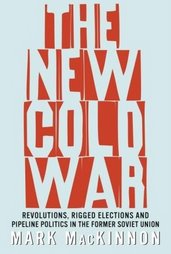
In my book The New Cold War: Revolutions, Rigged Elections and Pipeline Politics in the Former Soviet Union, I wrote about my concerns that Vladimir Putin's obsession with stability and the "power vertical" (stabilnost and vertikalny vlast) were populist code for eliminating such annoyances as free elections and independent media.
That's proven to be true, but it must be remembered that a wide majority of Russians continue to back Putin's policies (and those of his chosen successor as president, Dmitriy Medvedev, who in many ways still remains his mentor's underling). With the benefit of some time away, it's easier to see some of the reasons why. Simply put, Moscow is a safer and more prosperous place to live in 2009 than it was when Vladimir Vladimirovich succeeded Boris Yeltsin nine years ago.
A few little things that struck me:
* There is now an official taxi stand at the still-dilapidated Sherevmetyevo-2 airport that charges you a pre-set rate for trips to the city centre (i.e., no more arguing with bandits who will wait all day for a foreigner rich and stupid enough to pay their price).
* I wasn't stopped once, during more than a week in Moscow and St. Petersburg, by police demanding to see our dokumenti and looking to extract bribes for invented problems with said documents, something that used to happen on a regular basis. Perhaps I look less like a Chechen like I used to. Or perhaps the crackdown on corruption has reached the police force. The only time we were stopped was when our cab driver was actually caught on a radar gun going over the speed limit. Yes, police in Moscow now use radar guns and care how fast you drive.
* The touts who used to harass tourists lining up to see the Kremlin and the Hermitage museum have all disappeared. (Though St. Petersburg is still an easy place to get your pocket picked. My wife and I witnessed a woman lose her camera on the Nevskiy Prospekt).
* An overall sense that Moscow, in particular, is a less chaotic place than it used to be, certainly than it was when we first arrived in late 2001.
* This Putin lookalike on Red Square thought I would pay 1,000 rubles (about $33) to have my picture taken with him. This one cost nothing.
That said, Russia is also one of the countries that has been worst hit by the economic crisis thus far (GDP shrank 7 per cent in the first quarter of 2009 ), and Moscow remains one of the most expensive cities in the world.
As in China, many in Russia have been willing to accept some restrictions on personal freedoms so long as the economy kept growing and their lives continued to improve. If that deal is broken, will the popularity of President Medvedev and Prime Minister Putin also take a hit?
The past few days have seen some of the largest anti-government rallies in recent years (such as the Communist Party gathering yesterday in Nizhny Novgorod) and heavy-handed government responses (such as a recent decision to dispatch Interior Ministry troops from Moscow to break up anti-government protests in the Pacific Ocean port of Vladivostok) -- the latter being a sure sign of government nervousness.
A test of where things are heading could come in the unexpected form of the mayoral elections for the city of Sochi, which is scheduled to host the 2014 Winter Olympics. Some 26 people threw their hats into the ring, including leading opposition figure Boris Nemtsov (briefly deputy prime minister during the Yeltsin years), celebrity ballerina Anastasia Volochkova (famously canned by the Bolshoi Theatre for being overweight), billionaire businessman Alexander Lebedev and acting mayor Anatoly Pakhomov, who has the all-important backing of Putin's United Russia party.
Nemtsov has already had ammonia thrown at him by unknown assailants dressed in women's clothing and Volochkova has apparently now been disqualified for leaving her birthday off one of the documents she submitted with her registration papers. A porn star and a prominent freemason have also joined the race. It's enough to make a former Moscow correspondent tear up with nostalgia.
Despite the ludicrous start to the campaign, there is a serious side: whoever emerges from the crowded field on April 26 will get a chance to promote their version of Russia on the world stage in five years time. Given the way elections are run these days in Russia, the safe money is always on the Kremlin's man.
Monday, March 30, 2009

Beijing: The man in the bathtub is Lai Changxing. He's reading a newspaper that says “Canada Real Estate News” and “Job Service Centre.” This is how China's Southern Weekly newspaper – and many ordinary Chinese – envision life in Canada for China's most wanted man, someone accused by Beijing of heading a $10-billion smuggling empire before fleeing to Canada in 1999.
With press like this, it's hard to believe sometimes, but there was a time – barely a decade ago – when this country's leaders referred to Canada as China's “best friend in the world.”
That statement, made by then-Premier Zhu Rongji during one of those ballyhooed “Team Canada” business promotion trips of the Jean Chrétien era, was perhaps an overstatement made by a very polite host, but there was a bit of substance to it at the time. Canadian-Chinese friendship dates back to the fabled Norman Bethune's battlefield medical work during the Sino-Japanese war and has accelerated since 1970 when Canada recognized the People's Republic, two years before Richard Nixon dared travel to China. The Globe and Mail even played a role, opening the first Western newspaper office here in 1959, back when it was still called Peking. Most importantly, there are 1.4 million Canadians of Chinese descent.
The Chrétien era was arguably the warmest stretch to date, in part because Canada's 20th prime minister was personal friends with former Chinese leader Jiang Zemin. In 2005, someone named Paul Martin took it a step further by signing a “strategic partnership” agreement with visiting Chinese President Hu Jintao and promising to double trade within 10 years.
It took less than four years for all that warmth to almost completely disappear. The Stephen Harper era has been catastrophic in terms of Ottawa-Beijing ties, to the point that Canada has become almost irrelevant here. (Charles Burton, who once served as a Canadian diplomat in China, wrote a devastating critique of what's wrong that's well worth a read. Or check out Colin Freeze's report that appeared in The Globe and Mail.)
In a sentence that summarized much of what Mr. Burton laid out over 25 pages, the Canada-China Business council recently warned that “Canada, despite its historic ties to China, is not seizing all of the opportunities China affords to investors and businesses.”
The two biggest irritants were Canada's decision to award honourary citizenship to the Dalai Lama (which was a good idea) and Mr. Harper's decision to skip last year's Summer Olympics in Beijing (which wasn't).
When asked why he takes stands that fly in the face of Canada's business interests in the world's largest market, Mr. Harper claimed that he doesn't want to sacrifice “important Canadian values” to the “almighty dollar.” Fine. And if Mr. Harper was going around the world defending human rights anywhere they were in danger, his hard-line China policy might make sense. But given his government's unquestioning support of Israel during its recent assault on the Gaza Strip (to pick one example that I have some familiarity with), it's clear that he's not going to win a Nobel Peace Prize any time soon.
The problem Mr. Harper and his coterie have is they see the world as divided up into “good” countries (like the United States, Taiwan and Israel) and “bad ones” including China and much of the Muslim world. We take tough stands about Tiananmen Square and Tibet, but don't bat an eyelash at Guantanamo Bay or Gaza. If we had a consistent, moral foreign policy based on “Canadian principles,” the tough stand vis-à-vis Beijing would make sense. But we don't, and it doesn't.
The fact is that only the pro-Israel lobby spends more time and money on lobbying Canadian parliamentarians than pro-Taiwan groups. (Taiwan was the top destination for freebie trips by MPs in 2007, and second to Israel last year), and so here we are. And Canada's relationship with the world's next superpower is in tatters.
The truth is that we're in serious danger becoming a “bad” country in China's eyes as well. Our Prime Minister boycotted their coming-out party last summer, when even George W. Bush and Nicholas Sarkozy found ways to attend either the opening or closing ceremonies of the Olympics. We grant refuge to their most wanted man (albeit because the aforementioned Mr. Zhu repeatedly declared that Mr. Lai deserved to be executed, which is pretty much a death sentence in a country where courts usually do as their told). And we harangue them about domestic issues from across the ocean, rather than in quiet face-to-face talks where Mr. Harper speaking his mind might actually have some impact.
The good news is that there are some inside the Canadian government that get it. We're in the process of opening six new trade missions in China, which should finally give us a diplomatic and commercial presence here worthy of the world's third-biggest – and fastest-growing – economy. And, for better or for worse, Trade Minister Stockwell Day is planning a visit here next month.
That's all well and good. But the word I'm getting from various sources is that the “face”-conscious Chinese leadership is going to hold a grudge until Mr. Harper repents and makes a full-on official visit to Beijing. Mr. Harper has suggested that such a trip is on the horizon.
I hate to agree with the Toronto Star, but for the sake of Canada's interests, and reputation, in China, the sooner he gets here, the better.
The case of the Impeccable underwear

Beijing: It was one of the most bizarre new stories in recent weeks, a quasi-clash between the American and Chinese navies in the South China Sea.
The incident, according to the various accounts, ranged at times between the very dangerous and the farcical, with five Chinese boats coming so close to the USNS Impeccable – waving Chinese flags and demanding that the American ship leave the area – that the Impeccable resorted to using fire hoses to force their pursuers back. Undaunted, the Chinese sailors stripped to their underwear and kept up their dangerous game of chicken.
American officials have condemned the Chinese actions and portrayed the incident as an example of growing Chinese aggressiveness, and many news organizations used the story as an opportunity to discuss China's plans to eventually build its first aircraft carrier.
But looking at a map of where the incident occurred (BBC has a nice one), I find myself wondering how the U.S. navy would respond to a Chinese spy ship floating so close to its territorial waters. (The Impeccable is an unarmed surveillance craft that specializes in tracking submarines. As noted on the Danwei website, the Impeccable also looks “like something in which a James Bond villain would plan world domination.”)
The South China Sea is a mess of duelling claims, with China, Taiwan, the Philippines, Malaysia, Brunei and Vietnam all declaring sovereignty over parts of it. It's also one of the most strategically important bodies of water anywhere, with some 10 million barrels of oil passing through every day aboard tankers. Underneath lies even greater treasure – somewhere 7.7 billion barrels and 28 billion barrels of crude oil. Hence the competing claims and the U.S. navy's interest in patrolling the region.
The area that the Impeccable was operating in was actually just outside of China's territorial waters, but within what is known under international law as its exclusive economic zone. So the American ship had a right to be there, though the law (to me) seems vaguer on whether foreign nations can park active military vessels in another country's economic zone.
Most Chinese are cheering on their navy's new willingness to give even the shirts off their backs for their country. “Let's send some ships to the American exclusive economic zone a few times to see the reaction of the U.S.,” a Shandong resident posted on the popular sina.com web portal. “We must control the deteriorating situation in the South China Sea by force,” chimed in blogger Wangfengchuizhou.
This may not go away soon. While Obama and Chinese Foreign Minister Yang Jiechi met last week in Washington to defuse tension over the Impeccable incident, the brouhaha escalated again shortly thereafter, when the Filipino parliament passed a law claiming sovereignty over parts of the Spratly Island chain that are also claimed by China. China responded by announcing it was sending its biggest and fastest patrol boat to the area, while the Impeccable is still floating around, now accompanied by a destroyer.
Friday, March 20, 2009
Random notes
* I spent last week in Tokyo, but where I really wanted to be was Osaka, where they were dredging up old statues of Colonel Sanders. Apparently, this means the Hanshin Tigers have a chance at baseball glory this year. They haven't won the national championship since elated fans tossed the Colonel and his secret recipe into the Dotonburi River in 1985, following the Tigers' last title win. Call it the Extra Crispy Curse.
* While the U.S. and China were playing strip tag in the South China Sea, Japan was sending off two of its own destroyers to join the international anti-piracy mission off the coast of Somalia. China has already done the same, but Japan's deployment is yet another stretch of its famously pacifist post-World War Two constitution. (On a related note, I dropped by Canada's own pirate hunters last fall. You can still read the article here.)
* Is there a ban on importing cheese into China? James Fallows of The Atlantic investigates over at his superb blog.
* I was saddened, but not surprised, to see that He Weifang, an outspoken law professor at Peking University, has been reassigned to the Western province of Xinjiang, an effective demotion that also takes Prof. He out of the media spotlight in Beijing. Prof. He knew that he was courting trouble when he signed Charter 08, a document that calls for democratic reform in China. When I last contacted Prof. He, he agreed to an interview, and then backed away a few days later. He explained that he was “reluctant to talk about the Charter at this moment.”
* Check out Stephanie Nolen's new blog, Subcontinental, among her latest writings from, er, the subcontinent, is a post from the Tibetan capital in exile, Dharamsala.
Tuesday, March 3, 2009
Free Liam Gallagher!

Beijing: Sigh.
So the powers-that-be here have decided that British rock band Oasis can't play their first-ever gigs in mainland China because Liam Gallagher (the Gallagher brother with the nicer voice and even less of a grasp on things like politics than his sibling) played at a “Free Tibet” concert on Randalls Island in New York in 1997.
That's the reason being given by the band, anyway. Oasis were scheduled to play a pair of shows in Shanghai and Beijing in early April and said in a statement that they were “bewildered” by the decision, which came just three weeks after the shows were announced.
“According to the show's promoters, officials within the Chinese Ministry of Culture only recently discovered that Noel Gallagher appeared at a Free Tibet Benefit Concert on Randall's Island in New York in 1997, and have now deemed that the band are consequently unsuitable to perform to their fans in the Chinese Republic … during its 60th anniversary year,” the statement reads.
Leaving aside the question of just exactly what or where the “Chinese Republic” is, the government-ordered cancellation is bad news for Chinese music fans, even those who aren't particularly keen on “Wonderwall” and everything that followed.
Here's an incomplete list of some of other musicians who played that day at Randalls Island: U2, R.E.M., Eddie Vedder, the Beastie Boys, Alanis Morissette, the Foo Fighters, Sonic Youth, the Mighty Mighty Bosstones, a Tribe Called Quest and Ben Harper. So the ban on Oasis might mean no shows by Bono, Pearl Jam or Alanis in the Middle Kingdom either, although Sonic Youth did play Beijing last year without any problems.
The Chinese government is hypersensitive regarding foreign artists performing here, particularly since last March, when Bjork – another singer who was on the stage that day in 1997 – finished a concert in Shanghai with her song “Declare Independence” and shouted “Tibet! Tibet! Raise your flag!” over the final bars. There was some chatter among Chinese music fans about what the notoriously unpredictable Gallagher brothers might do on stage.
(It's not just the Tibet issue that gets the censors back in their 1970s frame of mind. All major foreign acts need to submit a setlist to the authorities before performing; the Rolling Stones were famously made to drop several songs with “suggestive” lyrics before they were allowed to make their 2006 debut in China. “Brown Sugar,” “Honky Tonk Woman” or “Beast of Burden” all got excised for fear of what hearing such songs live might do to the locals.)
In my books, if the Chinese authorities were going to ban Oasis for a perceived offence to the people of China, they should have targeted the other Gallagher, Noel (the one with the unibrow who writes most of the better tunes), who made a far bigger error when he referred to Shanghai – maybe you've heard of it, population 18.9 million – as “the middle of nowhere” in an interview with That's Shanghai magazine.
The good news is that an April 7 Oasis show in Hong Kong is apparently still going ahead. “One country, two systems,” the formula under which Hong Kong was absorbed back into China in 1997, apparently means one concert for 1.3 billion people.
Subscribe to:
Posts (Atom)