Twitter Updates

    follow me on Twitter

    Sunday, September 30, 2007

    Early reports of violations in Ukraine

    Just a quick note to pass on a report I got from a friend who is an international monitor observing today's Ukrainian parliamentary elections. He's in the Crimea (a stronghold of the pro-Russian Prime Minister Viktor Yanukovich) and passed along these notes:

    (Bits in square brackets are my additions for clarity's sake. My source can't be named at this point.)

    The most egregious rule breaking I've witnessed and documented to date:

    1) Voters lists being added to during the course of Election Day. I took a photo before I was prevented from taking any more pictures, interference [with the election monitoring team] which is also contrary to regulations.

    2) Russian citizens using their Russian passports to vote. Despite commision head's denial I stopped a voter who had just finished casting her ballot and admitted she was not a Ukrainian citizen.

    3) Two polling stations in which contrary to the rules thousands of ballots not fully distributed and held back in a safe to which only Party of Regions [Yanukovich's party] official had access.


    Sounds to me like more of the usual shenanigans. I'd like to hear from an observer in the west of the country if there's one out there who happens to be reading this.

    The Committee of Ukrainian Voters, an American-funded non-government organization, is also posting reports (in English and Ukrainian) throughout the day.

    Through the early hours they had observed "critical" problems with the voters lists, "occasional" instances of open bribery and, perhaps most significantly, the barring of some 570,000 Ukrainians who had recently travelled abroad because the State Border Service had not updated the voters list when they returned to the country. Despite all this, the CVU also declared that "no gross violations" had been registered as of this morning (Ukraine time).

    Turnout was on pace for 65 to 70 per cent, the CVU said. Should be an interesting day.

    Saturday, September 29, 2007

    Street theatre season begins


    In the Soviet era, questions of power and politics were decided by a small group of men, meeting in private within the red walls of the Kremlin in Moscow. The masses in far-flung places like Tbilisi and Kiev played no role whatsoever in deciding whether Nikita Khrushchev should remain in power in 1964, or who would replace Leonid Brezhnev as their leader after his death in 1982.

    These days, however, the masses rule. Or at least whoever can get the masses out on his side does.

    Protests against Georgian President Mikhail Saakashvili began today in Tbilisi. Duelling demonstrations by the supports of Ukrainian President Viktor Yushchenko and his archrival, Prime Minister Viktor Yanukovich, could begin as early as Sunday (I'll be on CTV's flagship morning program Canada AM Monday morning to talk about why).

    And Russia's Duma elections this December, as well as the presidential elections coming in the spring, are expected to be marked by some of the largest protests (both for and against the current establishment) that country has seen since the Soviet Union collapsed in 1991.

    The Georgian protests (pictured) were sparked by a chain of events that first saw former defense minister Irakli Okruashvili make astonishing allegations that Saakashvili was not only corrupt, but had once ordered him to kill businessman Badri Patarkatsishvili. (He also suggested a government cover-up in the mysterious 2005 death of former prime minister Zurab Zhvania, saying Zhvania had died somewhere besides where his body was found.)

    Two days later, on Thursday, Okruashvili was arrested and charged with extortion, money laundering, misuse of power and criminal negligence. Yesterday, his supporters took to the streets, 6,000 to 7,000 of them, according to Georgia's The Messenger newspaper.

    Even without the usual Washington-versus-Moscow overtones, it would be a pretty complicated drama. But as Olga Allenova wrote in Russia's Kommersant newspaper, it's likely Moscow that encouraged Okruashvili to take on Saakashvili head-on. Whatever the truth of the back-and-forth allegations of criminality, the Kremlin has tired of Saakashvili, who came to power through the American-backed Rose Revolution in 2003, and is supporting Okruashvili's push to oust him. Post-Rose Revolution, the way to do that is to make it appear as though the streets are with your man.

    A similar dynamic is playing out in Ukraine, where both the Kremlin-backed Yanukovich and the Western-friendly Yushchenko are each accusing the other side of election fraud before the first ballots are even cast.

    The elections are so close that some tampering seems inevitable. "Half of Ukraine supports Orange [Yushchenko and his Orange Revolution ally Yulia Tymoshenko], and the other half Blue [Yanukovich], so a tiny additional margin added by cheating could make all the difference," Roman Koshovi, Lvov chairman of the Committee of Ukrainian Voters, an election-monitoring group, told my friend and colleague Fred Weir of the Christian Science Monitor. "The temptation to fix some ballots will be very strong on all sides," Koshovi added.

    And when the cheating happens, people like Committee of Ukrainian Voters and the election monitoring team sent by the Organization for Security and Cooperation in Europe will be there to catch them and tell the world (or at least the Western media).

    Which is why Canadian politician Gerard Kennedy got in trouble with the Donetsk cops today. With the stakes so high and the race so close (polls put Yanukovich ahead, but with the "orange team" attracting roughly the same amount when Yushchenko and Tymoshenko's support is combined), international monitors are seen not as arbiters, but as potential instigators. What they say could influence how big, and how motivated, the crowds in the streets are the next day.

    As an aside, Canadian monitors are also seen as highly partisan, after some of them were spotted wearing orange during the 2004 showdown.

    Whoever wins in Ukraine, the other side is likely to try and reverse the result on the streets of Kiev. Both Yanukovich and Tymoshenko already have their tent cities set up.

    Yanukovich's people are already camping on Independence Square, the site of the Orange Revolution three years ago. Tymoshenko's followers on Sofievsky Square, a few blocks up the hill.

    Stay tuned. Just like in Georgia and Russia, the Ukrainian elections won't end when the voting does.

    Thursday, September 27, 2007

    The new face of Russian "extremism"


    Forget about the 10,000 skinheads, Rodina and Vladimir Zhirinovsky. It turns out that the real extremists in Russia are people like the nice man in the photograph, Andrei Piontkovsky.

    Piontkovsky has been charged with extremism in connection with two of his books, "Unloved Country" and "For the Motherland! For Abramovich! Fire!" (He also has another book, translated into English called "Another Look Into Putin's Soul" that you can buy here. Some might take the fact that the Kremlin doesn't want you to read it as recommendation enough...)

    The idea that Piontkovsky, a member of the liberal Yabloko party, is an extremist is absurd. He is a right-winger, yes, deeply opposed to the Putin regime, for sure, and someone with thick ties to the American establishment (I met him last year at the Hudson Institute, a right-wing think tank here in Washington D.C.). But none of those things should be illegal in a country like Russia that still pretends at being a democracy.

    The fact that he's been charged with inciting hatred against Russians, Americans and Jews deepens the farce. Piontkovsky, it should be noted, is a Russian Jew who spends a good chunk of his time in America. There are few people in the world less likely to hate Russians, Americans and Jews. At his trial in Moscow, the prosecutor couldn't even cite which passages of Piontkovsky's writing were doing the inciting.

    Simply put, Andrei Piontkovsky is in trouble because he's one of the Kremlin's most vocal and effective critics. He also speaks and writes in English, which made him a favourite of the Western media.

    Russia's recently amended extremism laws (which were broadened this year after charges against opposition leader Garry Kasparov failed to stick) are nothing but tool for suppressing political opponents. According to a story in today's Washington Post, other people being investigated for "promoting extremism" right now are Vladimir Pribylovsky, another liberal (and quotable) favourite of the Western press, and human-rights advocate Lev Ponomarev, who notably was among those who led the demonstrations that stopped the hard-line coup and brought about the fall of the Soviet Union in 1991.

    Like Piontkovsky, Pribylovsky had written extensively on the corruption of Russian democracy. Ponomarev's most recent "crime" was to organize a day of mourning on Moscow's Lubyanka Square (right in front of the KGB/FSB headquarters) for the victims of 2004 Beslan school massacre.

    These are not extremists. These are people who dream of a different Russia than the one they currently live in.

    Wednesday, September 26, 2007

    Zero hour approaches in Ukraine

    Election day is just four days away in Ukraine. The protests about the fairness of the vote, it seems, will begin as soon as the polling stations close.

    Two bits of news today that make some sort of repeat of the street theatre of 2004 seem almost inevitable.

    First, Prime Minister Viktor Yanukovich told regional television in the eastern oblast of Poltava that he would be bringing his supporters to the streets of Kyiv on Sunday night to protest what he says will be electoral fraud perpetrated by the erstwhile "team" of Viktor Yushchenko and Yulia Tymoshenko.

    "We see that orange team (Yushchenko) and white brotherhood (Tymoshenko) will not win the election honestly. And they feel this. Their rating is falling. They see they will lose, that is why they are preparing for the falsifications," Mr. Yanukovich said. "We have enough power not to allow this."

    Forget the absurdity of Yanukovich - who was behind the spectacular election fraud of three years ago that sparked the Orange Revolution - accusing anyone else of planning to rig an election. What's important here is that he does have enough money and support to make a mess of the coming election.

    Yushchenko, for his part, sees the trouble coming, and has rightfully pointed out that it's up to the prime minister and his government to oversee the vote. He alleged that it's Yanukovich (again) who is plotting to defile the results of the vote.

    "I want to make it clear to Mr. Yanukovych and his team: the government bears personal responsibility for holding honest, transparent and democratic elections," the president said on a visit to Sumy. "Why does Mr. Yanukovych speak about fraud? This is because he is planning it."

    What can we draw from all the threats and acrimony, so close to voting day? My conclusion is the same as Eugene Ivantsov's, who wrote this in Ukrainska Pravda.

    "The Parliamentary election will not be over after polling stations close in the evening. This election will most likely begin after that."

    Pity the ordinary Ukrainians who are trapped in this never-ending tug-of-war.

    Sunday, September 23, 2007

    I'm readable and astute

    I really am. Or at least the good people at The Messenger, Georgia's top English-language daily newspaper say I am.

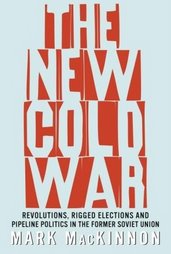
    Writer Christina Tashkevich reviewed my book, The New Cold War last week and concluded that the book deserved a "thumbs up."

    Thorough reporting, interesting accounts, and a fascinating revival of the past events give the book a thumbs-up. The author’s account of how each former revolutionary republic is doing now, after events, is particularly worth a glance over to see where he suggests progress has been made and problems encountered.


    The review ran under the headline "Canadian journalist’s 'The New Cold War' readable, astute."

    What made me proudest, though, was that Tashkevich wrote that although I had the viewpoint of a "foreign observer" to Georgia's Rose Revolution and the other events that make up the heart of the book, "[MacKinnon] comes to the same conclusions as us, the people who have been at the center of all these events."

    I can think of no higher compliment for a foreign journalist to receive.

    Just a reminder that the book (finally) lands on American shelves at the start of October. If you're in Washington D.C., please swing by the National Press Club on Sept. 27 to say hello and celebrate with me a little bit.

    Friday, September 21, 2007

    The failures of Viktor Yushchenko


    When Ukrainian President Viktor Yushchenko this week told my friend Ron Popeski (the Reuters correspondent in Kyiv) that he could envision Yulia Tymoshenko as prime minister following the Sept. 30 parliamentary elections, he was admitting two things:

    1) That he erred (although he rightly suggests there's plenty of blame to go around) in firing Tymoshenko back in 2005, thereby rupturing the "orange" coalition that brought him to power. Although he doesn't go on to say it, Yushchenko surely knows he made an even bigger error by replacing her with his old enemy Viktor Yanukovich - a move that led directly to the current political crisis. (As an aside, and proof that Yanukovich never changed his stripes, read this tale about how three years later, the prime minister still can't stand to even look at the colour orange.)

    2) That his own Our Ukraine movement is now a spent political force, meaning there's virtually no chance the premier will be coming from its ranks. It's Tymoshenko or Yanukovich. (The latest polls show Yanukovich's Party of Regions leading with about 31 per cent of the vote, with the Yulia Tymoshenko Bloc running second at 19 per cent. Our Ukraine trails with just under 16 per cent, with the Communists and perhaps one other party looking likely to crawl over the 3 per cent barrier needed to win seats in the Rada)

    How did we get here?

    Ask a Ukrainian who lives west of the Dnipr River what they think of Viktor Yushchenko and they'll likely respond with a sigh and a shake of their head. After putting so much blind faith in him during the heady days of the Orange Revolution, they feel incredibly let down. Even betrayed.

    Two unsolved mysteries have come to symbolize how quickly the air went out of the orange balloon: the 2000 murder of investigative journalist Heorhiy Gongadze (pictured) and the near-fatal poisoning of Yushchenko himself during the 2004 presidential campaign.

    When I met with the president at his office in Kyiv earlier this year, he told me that "certain progress" was being made in the poisoning investigation. "The investigators have received sufficient data on how this poison works, and what’s the technology of its application. Where the poison could be produced, in which lab, and how it could be delivered to Ukraine," he told me. (To read a complete transcript of the interview, click here.)

    Yushchenko made it sound like investigators were closing in on the truth, but since then we've heard nothing. We've heard even less about the investigation into Gongadze's killing, a case that's nearly as important to Ukrainians. Gongadze's murder, and the evidence pointing to former president Leonid Kuchma's office, ignited the groundswell of protest that culminated in the 2004 uprising. Many who stood on the streets during the Orange Revolution cited their disgust at the poisoning of Yushchenko and the grisly Gongadze killing as reasons they decided to take action.

    They want the culprits - whether they be in Kyiv or Moscow, part of the current administration or the last one - identified and brought to justice. But it's looking increasingly unlikely that will ever happen.

    Earlier this month, the International Federation of Journalists criticized the Ukrainian government for lacking the "political will" to pursue the Gongadze case to its conclusion.

    Unfortunately for Yushchenko, many Ukrainians are looking at the two cases and concluding that perhaps he also lacks the political will to lead.

    Wednesday, September 19, 2007

    The Putin years


    Kommersant has begun what we're told will be an eight-part series examining Vladimir Putin's legacy in office (based on Kommersant's assumption that "it would seem that he is in fact going to leave office"). The period of 2000-2008, the paper surmises, will be remembered as the Putin "era" - one that will be remembered primarily for such shocking events as the tragic sinking of the Kursk, the horrifying Beslan school siege and the Soviet echoes of the Yukos affair.

    All three were scandalously managed by the Kremlin. It's difficult to imagine any Western leader surviving one such debacle, let alone all three, with his or her popularity intact.

    And yet Putin did, his popularity never dipping below a stratospheric 70 per cent for a prolonged period of time. The rest of Part One of the Kommersant series goes a long way towards explaining why.

    (It should be noted here that despite being owned by Alisher Usmanov, a businessman with close ties to the Kremlin, Kommersant is still seen as a largely independent voice. Unlike most of the now-docile Russian media scene, the paper regularly prints articles that displease the authorities.)

    As they say in American politics, "it's the economy, stupid." The Kommersant series kicks off by looking at the social and economic progress made since 2008. The overall assessment is glowing:

    "During the eight years that Putin has been in office the income of Russians has grown quickly; the country’s history has hardly seen another period when the prosperity of the population improved at such a fast rate," the article reads. "The Kremlin can boldly state that as far as the population’s standard of living is concerned, he has succeeded in wiping out the consequences of the 'Yeltsin chaos' of the 1990s."

    The last line is one of the hardest truths for the liberal opposition in Russia to deal with: when they attack Putin (quite justifiably) for the systematic evaporation of freedoms during his "era," they have to be careful not to sound like they're calling for a restoration of the Yeltsin years. The West (and the oligarchs who unfortunately hover around the opposition) may remember that time as halcyon, but the ordinary Russian recalls only the chaos - and the poverty they were forced to endure in the name of "freedoms" and "democracy."

    As Kommersant explains, the Putin years saw more Russians emerge from the black market, more income from the private sector and more Russians reaching their own definition of "middle class."

    Though the black market is still bigger than the legal one in Russia - a massive problem for Putin and whoever succeeds him - legal earnings now make up 48 per cent of a Russian's income, up from 38 per cent at the start of the decade. The percentage of a family's income that comes from the legal private sector (as opposed to the black market or the government) grew from just 9.2 per cent in 2000 to 19.5 per cent by 2006.

    Perhaps most crucially, Kommersant notes that "the Russian middle class is made up of people who, because of their education and professional qualities were able to adapt to the market. According to the [Expert-Data] agency, this middle class made up 15% of the population in 2001 and 37% in 2005."

    But while the big numbers are all looking up (something many experts believe should be attributed more to rising oil prices than any policies of Putin's), Putin has clearly failed to reduce poverty, something he repeatedly identified as a government role. In fact, poverty levels remained stubbornly high during the Putin era, while income inequality grew.

    "The income of the richest 20% of households was 6 times richer than the poorest 20% of households. To compare, this factor was only 5.2 in 2005. Measured by expenditures, the split is even greater: a factor of 6.7 in 2005 and 8.9 in 2006. This spread points to a colossal difference in lifestyle – but not in terms of mansions and limousines. The best-off Russian families, compared to their poorest countrymen, spend 7.7 times more on fruits and vegetables, 10 times more on alcohol and 12.6 times more on meals outside the home.

    "The unevenness of income growth calls into question the possibility of ending poverty in Russia.... The poverty level ratings vary greatly depending on who you consider to be poor. According to Rosstat, in 2000 42.3% of Russians had incomes below the cost of living. In 2004 25.5% of Russians earned less than the cost of living. However, the percent of families who receive charity or help from relatives is growing steadily. Currently 29.9% of the population fits this category. In other words, whatever the statistics say, one third of families are poor enough to accept material support from those around them."

    It's a fascinating start to the series, which the paper promises will include future articles examining the state of the education system (my assessment: getting better, but with dark trends including politicization of the curriculum to whitewash Soviet and KGB history), governance (less open, less accountable than under Yeltsin) and the army (still decrepit, despite recent stunts intended to demonstrate otherwise).

    Last remark: the photo above (first noticed by Russian blogger Drugoi, which translates as "The Other") was taken last week on Moscow's Leninsky Prospekt, walking distance from my old home on Kaluzhskaya Ploschad. The billboard reads "Putin's Plan - The Victory of Russia!" Other bloggers say they've gone up all over the city.

    On his blog, Drugoi wonders if anyone knows what the plan is. My question is similar to one I've asked before - if Putin's really stepping down in six months (as he is constitutionally obligated to do), why are we still discussing "Putin's plan"? Why aren't we seeing billboards hailing the competing and contrasting plans of Sergei Ivanov, Dmitriy Medvedev, Mikhail Kasyanov or Viktor Zubkov?

    The only answer that makes sense is that some people in the know don't believe the Putin era really ends in 2008.