Who do Russians want to see in the White House? What do the looming changes in leadership, both in Moscow and Washington, likely mean for the increasingly confrontational relatioship between the Kremlin and the West?
Both questions were put to me by an astute and concerned audience in London this week who came out to hear me chat about
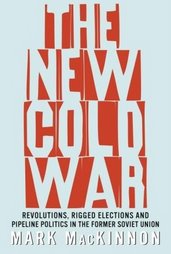
The New Cold War during a pleasant night at The Gallery in Farringdon. Both issues will again be hotly debated at the Eurasian Media Forum, which begins tomorrow here in Almaty, Kazakhstan.
The short answer to the first question is that none of the remaining U.S. presidential contenders are particularly palatable to the Kremlin.
Broadly speaking, most Russians would prefer to see a Democrat in the White House. But neither Hillary Clinton nor Barrack Obama comes without baggage on the Russia front.
Clinton, who would likely win the Russia primary if the world were given a chance to vote, reminds Russians, of course, of her husband Bill's era. While Mr. Clinton was personally popular - his extramarital shenanigans played much better in laissez-faire Russia than they did back home - Russians also harbour resentment at him for the way he ignored Moscow's concerns during the last Kosovo crisis and the 1999 bombing campaign against Serbia.
Ms. Clinton also embarrassed herself when she tried, and failed, repeatedly to remember the name of Russia's president-elect ("Meh, uh, Medevedeva - whatever"). Like presumptive Republican nominee John McCain, Clinton has
dismissed Medvedev on the campaign trail as a Putin puppet and been harsh in her condemnation of Russia's sitting president, saying that as a KGB agent, Putin "by definition he doesn’t have a soul."
Harsh words that will hardly serve to defrost relations if Clinton suprises pundits and manages to win the presidency. But to the Kremlin, she's someone they feel they know and understand - thereby easier to deal with than either Barrack Obama or John McCain.
It's not just the Kremlin - an
opinion poll conducted in February by the All-Russian Public Opinion Research Center (better known by its Russian acronym, VTsIOM) found that if they were given a chance to vote in the Democratic primary, Russians would choose Clinton over Obama by a nearly five-to-one margin.
Part of that, sadly, can likely be chalked up to rampant racism in Russian society. Very few Russians could fathom a
chorniy, a black, being the most powerful person on the planet.
Obama has actually said little about what his Russia policy might be, but we can draw conclusions from the
company he's decided to keep. His top Russia advisor is
Michael McFaul, a respected Stanford University academic and
a harsh critic of both Vladimir Putin and the system of "managed democracy" the Kremlin has installed over the past eight years.
On the other hand, he's called for Russia to be included in NATO as a way of resolving trans-Atlantic tension. On that point, I think he's ahead of his time.
More ominous, to many Russians, is the presence of
Zbigniew Brzezinski, Jimmy Carter's former National Security Advisor, on Obama's foreign policy team. Brzezinski is an Old Cold Warrior who was among the first to call for the West to confront Putin. He also played a key role in both promoting the Baku-Tbilisi-Ceyhan pipeline (which expensively serves the sole purpose of getting Caspian Sea crude to markets in the West without ever crossing Russian soil) and in rallying diplomatic support for Ukraine's pro-Western Orange Revolution in 2004.
But even the presence of Brzezinski doesn't mean Obama will necessarily abandon his pledge to be a less confrontational U.S. president than the outgoing George W. Bush. In fact, both Democrats have made clear that they favour diplomacy over confrontation when it comes to Russia.
John McCain promises to take the opposite tack. In fact, he's frequently been critical of the Bush Administration for being too soft on Russia.
“I looked into Putin’s eyes, and I saw three things, a “K’ a “G’ and a “B,’” is a line McCain has pulled out more than once during his push for the presidency. It's a pointed jab at Bush's palsy relationship with Putin, and Bush's famous remark after his first meeting with the Russian leader that after looking in Putin's eyes he "got a sense of his soul."
While in the Senate, McCain was the most outspoken U.S. politician in calling for the West to confront Putin and Putinism. He also headed the USAid-funded International Republican Institute at a time when it played a key background role supporting both the 2003 Rose Revolution in Georgia and Ukraine's popular uprising a year later. (That's him in the picture with buddy Joe Lieberman sporting orange scarves during the Orange Revolution. Hillary seems to have forgotten hers. At least she's not wearing blue...)
McCain, who has called for Russia to be expelled from the G-8, was charateristically harsh after Medvedev handily won the March 2 presidential elections:
"In an election that was uncontested, where opposition candidates were either suppressed or arrested, where the result was foreordained by the manipulations of a corrupt and undemocratic regime, the one thing that was never in doubt was the result. It is a tragedy of history that at this moment, when the democratic tide has reached more nations than ever before, the Russian people be again deprived of the opportunity to choose their leaders in a free and open contest," McCain said in the statement.
"It is obviously an election that did not pass the smell test … These elections were clearly rigged."
Can't argue with much of that. But you have to wonder how that first McCain-Medvedev summit would go. The Moscow News
suggests that a McCain presidency would mean "the end of U.S.-Russian diplomatic niceties."
(As an aside, McCain's speechwriter is Robert Kagan, one of the architects of the argument for invading Iraq. How do these people manage to stick around after being so monumentally, disastrously, wrong?)
So the Kremlin, if it had a ballot, would vote for Hillary, and would take Obama over McCain.
The other side of the equation, of course, is Medvedev. What kind of president would he be, and how might he alter the course of Russian-American relations?
Analyst Andrei Piontkovsky, who I have a lot of respect for,
believes that the fact Medvedev was chosen to succeed Putin over the more hawkish Sergei Ivanov, means that "we have reached the end of the latest negative confrontational cycle."
I'm less sure. It seems to me that Putin - who in addition to becoming Medvedev's prime minister has
"agreed" to take over the leadership of the United Russia party - has now made it abundantly clear that he will remain the real authority. Medvedev's reported pro-Western bent will mean nothing if Putin and the
siloviki are maintaining control of foreign and defense policy as the
Vedomosti newspaper recently
speculated.
Gleb Pavlovsky, who as one of the architects of managed democracy is in a position to know, suggested that the new Russian power system will be a trifecta of the presidency, the parliament and the cabinet of ministers. I don't think it escaped him that Putin controls two of those three power centres to Medvedev's one.
So the odds are that, no matter who wins the White House, we'll see the same escalating confrontationalism that has marked the past eight years.
Incidentally, I'm sharing the stage with both Brzezinski and Pavlovsky tomorrow morning at the
Eurasian Media Forum. I'll let you know if I get a word in edgewise...