So Oleg Deripaska is making a $1.54-billion investment in Canadian auto parts giant Magna International. The Globe and Mail reports today on how buying into Magma could be a backdoor way for the oligarch to gain control of American auto giant DaimlerChrysler.
While there's nothing inherently sinister about that, it's worth noting that Deripaska is seen as the closest to the Kremlin of Russia's remaining oligarchs, largely because he often does the president's bidding. The Globe also reports on how Magma boss Franch Stronach met with President Vladimir Putin before agreeing to the deal.
Unlike his fellow billionaires Vladimir Gusinsky, Boris Berezovsky and Mikhail Khodorkovsky, Deripaska followed the "stay out of politics" warning Putin delivered to the oligarchs after he was first elected in 2000. Those who tested the new president soon wound up either in exile (Gusinsky, Berezovsky) or in a Siberian labour camp (Khodorkovsky). But Deripaska played by the new Kremlin's rules and emerged, by some counts, as Russia's richest man.
It probably doesn't hurt that Deripaska is married into the family (often referred to as The Family, with all the mafiaesque implications intended) of former president Boris Yeltsin. But he's also played it smart, pandering to the current occupants of the Kremlin by investing in a way meant to please. Most obsequiously, his holding company last year poured $800-million into a sports complex near Russia's Black Sea resort of Sochi.
If Sochi wins its bid to host the 2014 Winter Olympics, that might look like a smart investment. Otherwise, it's $800-million down the drain of appeasing the Kremlin, which in Russia is a smart investment anyway.
The Magna investment is also likely to cheer the president. Consider Putin's Feb. 7 address to the Russian Union of Industrialists and Entrepreneurs (effectively the oligarchs' club): "The time has come to expand the participation of our enterprises in international cooperation and the realization of serious commercial initiatives abroad," he told them at a meeting inside the Kremlin walls.
In other words, let's start using our new economic clout to increase our political influence in other countries. While he warned his audience not to use words like "conquer" or "expansion" when speaking of foreign markets, lest it frighten the locals into thinking the Russians are up to something, Putin said that "it goes without saying that the diversification of the Russian industry is becoming one of our main and common economic priorities."
Almost three months to the day later, the deferential Deripaska has already delivered. If you're a Russian oligarch who acquired your money in a shady fashion in the 1990s, doing what the president asks of you is the smartest way to stay out of jail.
Friday, May 11, 2007


Wednesday, May 9, 2007
The rise of Nashi

The AFP newswire just moved an interesting story about the growing rent-a-crowd trend across the former Soviet Union. The clearest example of this in recent months was Viktor Yanukovych's limp "Blue Revolution" on the streets of Kyiv, where protestors spoke openly of having been paid $10 (sometimes more) to stand in Independence Square and wave a blue flag.
Those demonstrations were so pitiful as to be almost laughable. But some aren't funny at all.
Take Nashi. The Kremlin-founded youth group has staged protests in Moscow, Pskov and Tallinn during the ongoing Bronze Soldier dispute between Russia and Estonia, at one point putting physical chase to the Estonian ambassador to Moscow.
In the eyes of some, Nashi are the modern equivalent of the Komsomol, the Young Communists of the Soviet era. Then, and increasingly now with Nashi, being a member put you on track to a more successful career, and past membership was effectively a prerequisite if you aspired to a job in the bureaucracy or the security services.
To others, Nashi are the Brownshirts of an increasingly despotic Russia.
Nashi (the word means "Ours") are the creation of Vladislav Surkov, Putin's deputy chief of staff and powerful Kremlin spin doctor Gleb Pavlovsky. Charged in the wake of Ukraine's Orange Revolution with making sure revolutionary tents were never pitched on Red Square, the two decided to implement strict new restrictions on Western NGOs (read Surkov's paranoid secret speech on NGOs and conspiracies against Russia here). Then they created Nashi, a group they hoped would serve as a counterweight to rabble-rousing pro-Western groups like Kmara in Georgia, Pora in Ukraine and now Oborona in Russia. Today the group claims to have tens of thousands of members.
My fear about Nashi is that it dangerously plays with one of the most disturbing trends I witnessed during the three years I lived in Moscow: the growing "Russia for the Russians" sentiment across the country. Towards the end, it seemed like that there was another report every day in the newspaper of a foreigner being beaten or stabbed by ultranationalist thugs.
At the group's founding meeting at a summer camp outside of Moscow two years ago (an event closed to the foreign press), Pavlovsky made clear two a crowd of 3,000 young activists what their role was going to be: "You must be ready to disperse fascist rallies and physically oppose attempted anti-constitutional coups." In other words, make sure that any attempt at a peaceful revolution like the one that happened in Ukraine the year before doesn't stay peaceful for long.
Sunday, May 6, 2007
Liberal imperialism and Estonia
Estonians are the latest to experience the Kremlin's new tool for controlling its neighbours: energy. They're learning (as Ukrainians, Belarussians, Latvians, Lithuanians and Georgians already have) that their big neigbour to the east is ready and willing to fight dirty as it tries to reel its former colonies back in.
It's what Anatoliy Chubais, the head of Unified Energy Systems, described a few years ago as "liberal imperialism" - using Russia's abundant economic levers to restore the country's dominant position over Eastern Europe, the Caucasus and Central Asia.
Foremost among the tools at the Kremlin's disposal is Moscow's control over a staggering share of the region's oil and gas resources. Much of the former Soviet Union and Eastern Europe is entirely reliant on Russian natural gas. Increasingly, so too is the European Union.
That position gives the Kremlin a dangerous trump card in any dispute, as we're now seeing as the Bronze Soldier affair between Russia and Estonia continues to escalate. On May 1, Russia cut off oil and coal exports to its much-smaller neighbour, ostensibly because of railway "repairs," but in reality to punish Estonia for supposedly insulting Soviet war dead.
This is hardly the first time we've seen the Kremlin act like this. And, as journalist Derek Brower noted on lawyer-blogger Robert Amsterdam's site, each case has been more egregious than the last.
In frigid January 2006, Moscow briefly cut off the flow of natural gas to Ukraine in a pricing dispute that had the intended side-effect of scaring many Ukrainians into voting for the Kremlin-friendly Party of Regions and its leader Viktor Yanukovich in parliamentary elections two months later. With a single flip of the switch, the Kremlin had undone much of the strategic loss it suffered in 2004 when the pro-Western Orange Revolution swept Viktor Yushchenko to office.
Earlier this year, Gazprom did it again, threatening to cut off the flow of gas to Belarus, and only backing down when Alexander Lukashenko's government agreed to sell it a 50 per cent share in Beltranzgas, the Belarussian company that operates the pipeline network that ships Russian gas to Europe (see map top left).
Similar tactics were used by the Gazprom to pressure Serbia in 2000 and Georgia in 2001 into giving in to the Kremlin's political demands.
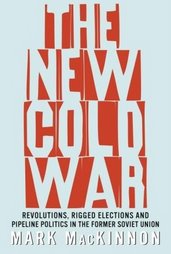
This is a major theme of my book, The New Cold War, which was published last month in Canada and hits U.S. bookstores in September.
Here's a bit of what I wrote on the topic:
As an aside, The Globe and Mail ran a review of The New Cold War on Saturday. Review Juliet Johnson, a political science professor at McGill University, said the book "wonderfully documents the conflicting interests and policies of Russia and the West in an engaging, easy-to-read style." You can read the whole review here.
It's what Anatoliy Chubais, the head of Unified Energy Systems, described a few years ago as "liberal imperialism" - using Russia's abundant economic levers to restore the country's dominant position over Eastern Europe, the Caucasus and Central Asia.
Foremost among the tools at the Kremlin's disposal is Moscow's control over a staggering share of the region's oil and gas resources. Much of the former Soviet Union and Eastern Europe is entirely reliant on Russian natural gas. Increasingly, so too is the European Union.
That position gives the Kremlin a dangerous trump card in any dispute, as we're now seeing as the Bronze Soldier affair between Russia and Estonia continues to escalate. On May 1, Russia cut off oil and coal exports to its much-smaller neighbour, ostensibly because of railway "repairs," but in reality to punish Estonia for supposedly insulting Soviet war dead.
This is hardly the first time we've seen the Kremlin act like this. And, as journalist Derek Brower noted on lawyer-blogger Robert Amsterdam's site, each case has been more egregious than the last.
In frigid January 2006, Moscow briefly cut off the flow of natural gas to Ukraine in a pricing dispute that had the intended side-effect of scaring many Ukrainians into voting for the Kremlin-friendly Party of Regions and its leader Viktor Yanukovich in parliamentary elections two months later. With a single flip of the switch, the Kremlin had undone much of the strategic loss it suffered in 2004 when the pro-Western Orange Revolution swept Viktor Yushchenko to office.
Earlier this year, Gazprom did it again, threatening to cut off the flow of gas to Belarus, and only backing down when Alexander Lukashenko's government agreed to sell it a 50 per cent share in Beltranzgas, the Belarussian company that operates the pipeline network that ships Russian gas to Europe (see map top left).
Similar tactics were used by the Gazprom to pressure Serbia in 2000 and Georgia in 2001 into giving in to the Kremlin's political demands.
This is a major theme of my book, The New Cold War, which was published last month in Canada and hits U.S. bookstores in September.
Here's a bit of what I wrote on the topic:
In czarist Moscow, before Communist dictators flattened entire sections of the once-charming city centre and filled it with buildings tall enough to match their egos, nothing stood higher than Ivan the Great’s Bell Tower, a white stone spire topped by a gleaming golden dome that still stretches above the Kremlin’s red walls. Before the Bolshevik Revolution of 1917, it was illegal to build anything in Moscow that exceeded the eighty-one-metre height of the Bell Tower, which stretches above a trio of magnificent Orthodox cathedrals — Assumption, Archangel and Annunciation — that house the tombs of a long line of czars, czarinas and crown princes. In pre-revolutionary Russia, it would have been hard to get past the impression that God and the czars—perhaps not in that order—were observing everything you did.
But in today’s Moscow, the building that stands imperiously over everything else in the city’s jumbled skyline is the thirty-five-storey grey concrete and blue glass headquarters of Gazprom OAO, the giant energy company that would become as vital to Vladimir Putin’s influence over Russia’s neighbours as the horse-borne Cossack armies had been to the czars, or the Comintern to Lenin.
(snip)
Putin realized that the West’s tolerance for using tanks and attack helicopters as a way of expanding influence was on the wane. Russia’s resurgent economic strength, as well as its abundant supply of natural resources—oil and, in particular, natural gas—could strengthen his hold on the near abroad far better than could any conscript soldier. He didn’t need to send in the army to settle a dispute. All he had to do was flip the switch and let the neighbours shiver until they came around to seeing things his way.
As an aside, The Globe and Mail ran a review of The New Cold War on Saturday. Review Juliet Johnson, a political science professor at McGill University, said the book "wonderfully documents the conflicting interests and policies of Russia and the West in an engaging, easy-to-read style." You can read the whole review here.
Friday, May 4, 2007
Ukraine heading to the polls

The standoff is over for now, and Viktor Yushchenko appears to have won the test of nerves against his arch-rival, Viktor Yanukovich. The two men announced today that they have agreed to hold new parliamentary elections in the near future, something Yushchenko has been demanding since dissolving parliament last month amid a bribery scandal.
So far, no date has been set, but Yushchenko said today that the vote would be held within 60 days. July 8 is the best guess of some people in the know.
Why did Yanukovich throw in his cards? Because his "Blue Revolution" on the streets of Kyiv was a failure. The demonstrations on Independence Square were lifeless affairs, and as word got out that most of the protestors were being paid to participate, the farce became more of an embarassment to Yanukovich than a tool for pressuring Yushchenko.
But the demos did serve a useful purpose for Yanukovich and his allies. When Yushchenko originally dissolved parliament on April 2, he set the fresh polls for May 27. At the time, people close to the Party of Regions told me that Yanukovich hadn't expected Yushchenko's move, and that the party was in no position to run an election.
Seeing the election date pushed back five or six weeks gives Yanukovich - whose party still maintains a strong lead in the polls over both Yushchenko's Our Ukraine movement and the Yulia Tymoshenko bloc - a chance to win the victory at the ballot box that he wasn't going to achieve in the streets.
How well the old Orange Revolution allies, Yushchenko and Tymoshenko, can cooperate over the campaign may determine whether Yanukovich and his Kremlin backers succeed.
Stay tuned.
Review of The New Cold War
A quick break from the news to point to a review of my book that I stumbled across on the website of Jeff Jedras, better known in the blogosphere as A BCer in Toronto. It's "a very enlightening read, well recommended," says Jeff of The New Cold War.
Read the rest here.
I'm told The Globe and Mail's review - ack! - is coming out tomorrow.
Read the rest here.
I'm told The Globe and Mail's review - ack! - is coming out tomorrow.
Tuesday, May 1, 2007
The struggle over history

The struggle for modern Russia is, in many ways, a struggle for its collective memory. What was the USSR, and how should it be remembered?
In the West, the answer is easy: the Soviet Union was the "evil empire" - an aggressive dictatorship that terrorized its own people and those in neighbouring countries.
To many Russians, especially those who suffered through the country's chaotic experience with democracy and free-market economics in the 1990s, the answer is less clear-cut. Disillusioned with what "freedom" brought them, many Russians now openly pine for the stability, or stabilnost, of the past.
I interviewed pollster Yuri Levada shortly before he died about the wave of nostalgia for the "good old days" that had helped to sweep Vladimir Putin to power and make him one of the most popular leaders on the planet. The first sociologist to conduct polls of how Russians felt, his surveys showed that when the USSR collapsed in 1991, 50 per cent of citizens still admired the totalitarian system that existed before Mikhail Gorbachev and perestroika.
Levada, at the time, had assumed that the number would eventually decrease as Russians became accustomed to Western-style democracy and capitalism. But shortly before his death last year, that number stood at 65 per cent. The people, he told me in an interview for my book The New Cold War, had come to believe that stability and order were more important than democracy and freedom.
That verdict is playing an important role in the flaring Russian anger over the Bronze Soldier affair in neighbouring Estonia. While Estonians, rightfully, view the arrival of the Red Army in their country as the day the Nazi occupation ended and another began, many Russians (like many Japanese) have never come to accept or understand how their country's dark history is viewed in the rest of the world.
There was some poignant writing on this by Boris Makarenko in Kommersant over the weekend:
First, let's remember that Riga and Tallinn were not liberated by our troops so much as taken: far from all of the inhabitants of the Baltic countries liked the Germans, but few wanted to fall under the scepter of the Kremlin. Like Eastern Europe, the Baltic countries were deprived by us of their right to free elections, but Prague and Budapest at least got to be their own countries and have their own national flags and symbols; they were not settled by a massive wave of Russian speakers; and if someone there was repressed, at least they were sent to a jail near home instead of being exiled to Siberia. Should we really be surprised that there was more rage in the Baltic countries after the departure of Moscow, even if takes such uncivilized forms?
Second, it shouldn't be forgotten that, in the eyes of the majority of Central Europeans, the liberation from fascism and even the Cold War do not justify the fact that soldiers in a foreign uniform and under a foreign flag stood between them and Europe for half a century. We have been laboring too long under the impression that the Central Europeans liked being in the Warsaw Pact – despite the evidence of the events in Berlin in 1953, Budapest in 1956, and Prague in 1968.
Levada's numbers showed that lesson isn't being learned. More dangerously, history is rapidly being forgotten.
In praise of the eXile
One of the oddest truths about reporting in Russia is that we - the Western press corps - often found ourselves outdone by a satirical local rag called the eXile.
Put together by a bunch of expats who have found a home in Moscow, the eXile blends sometimes hilarious, sometimes revolting features on living debaucherously in the Russian capital.
That wasn't the part that impressed the rest of us hacks. What did was the political reporting tucked in between the pages of "Death Porn" and "Whore-r Stories." Unlike much of the rest of what was produced by the Western journalists living in Moscow, the eXile doesn't buy the simple State Department narrative of "Russia intrinsically bad, West trying to save it."
Reporters like the eXile's Mark Ames see the "struggle for democracy" across the former Soviet Union for what it is: an arm-wrestle between the neo-cons in the White House and the neo-authoritarians in the Kremlin. Both sides say they're interested in the prosperity and freedom of the Russian people, in reality both are cynically pursuing their own, largely commercially oriented, agendas.
For a different perspective, check out the eXile's takes on the recent protests in Moscow and the ongoing standoff in Ukraine. Weed through the silly, self-indulgent bits and you'll get to a lot of nuggets that The Economist tends to brush by in its telling of the same tales.
And to head off the criticism that the eXile (like me) is too gentle on the current Kremlin, it's worth noting that they once ran a multi-page feature that was titled something like "99 ways that Putin's Russia is like Weimar Germany." I can't find it online anymore, but it was one of those pieces where you started out laughing, then got deeply unsettled as you considered the substance underpinning the humour.
Put together by a bunch of expats who have found a home in Moscow, the eXile blends sometimes hilarious, sometimes revolting features on living debaucherously in the Russian capital.
That wasn't the part that impressed the rest of us hacks. What did was the political reporting tucked in between the pages of "Death Porn" and "Whore-r Stories." Unlike much of the rest of what was produced by the Western journalists living in Moscow, the eXile doesn't buy the simple State Department narrative of "Russia intrinsically bad, West trying to save it."
Reporters like the eXile's Mark Ames see the "struggle for democracy" across the former Soviet Union for what it is: an arm-wrestle between the neo-cons in the White House and the neo-authoritarians in the Kremlin. Both sides say they're interested in the prosperity and freedom of the Russian people, in reality both are cynically pursuing their own, largely commercially oriented, agendas.
For a different perspective, check out the eXile's takes on the recent protests in Moscow and the ongoing standoff in Ukraine. Weed through the silly, self-indulgent bits and you'll get to a lot of nuggets that The Economist tends to brush by in its telling of the same tales.
And to head off the criticism that the eXile (like me) is too gentle on the current Kremlin, it's worth noting that they once ran a multi-page feature that was titled something like "99 ways that Putin's Russia is like Weimar Germany." I can't find it online anymore, but it was one of those pieces where you started out laughing, then got deeply unsettled as you considered the substance underpinning the humour.
Subscribe to:
Posts (Atom)